英検準1級でも難関大の英語が解けない理由――「1パラグラフ=1設問」の罠と、ケンブリッジ英検に学ぶ「真の読解力」
「英検準1級に合格したのに、早慶や国立大の二次試験の英語がさっぱり解けない……」
指導現場では、このような悩みを抱える受験生に頻繁に出会います。なぜ、高い語彙力を持ち、英検の難解な語彙問題をクリアした学生が、大学入試の長文読解で壁にぶつかるのでしょうか。
そこには、英検の長文問題が抱える**「構造的な弱点」**が深く関わっています。
指導現場では、このような悩みを抱える受験生に頻繁に出会います。なぜ、高い語彙力を持ち、英検の難解な語彙問題をクリアした学生が、大学入試の長文読解で壁にぶつかるのでしょうか。
そこには、英検の長文問題が抱える**「構造的な弱点」**が深く関わっています。
「1パラグラフ=1設問」という親切すぎる罠
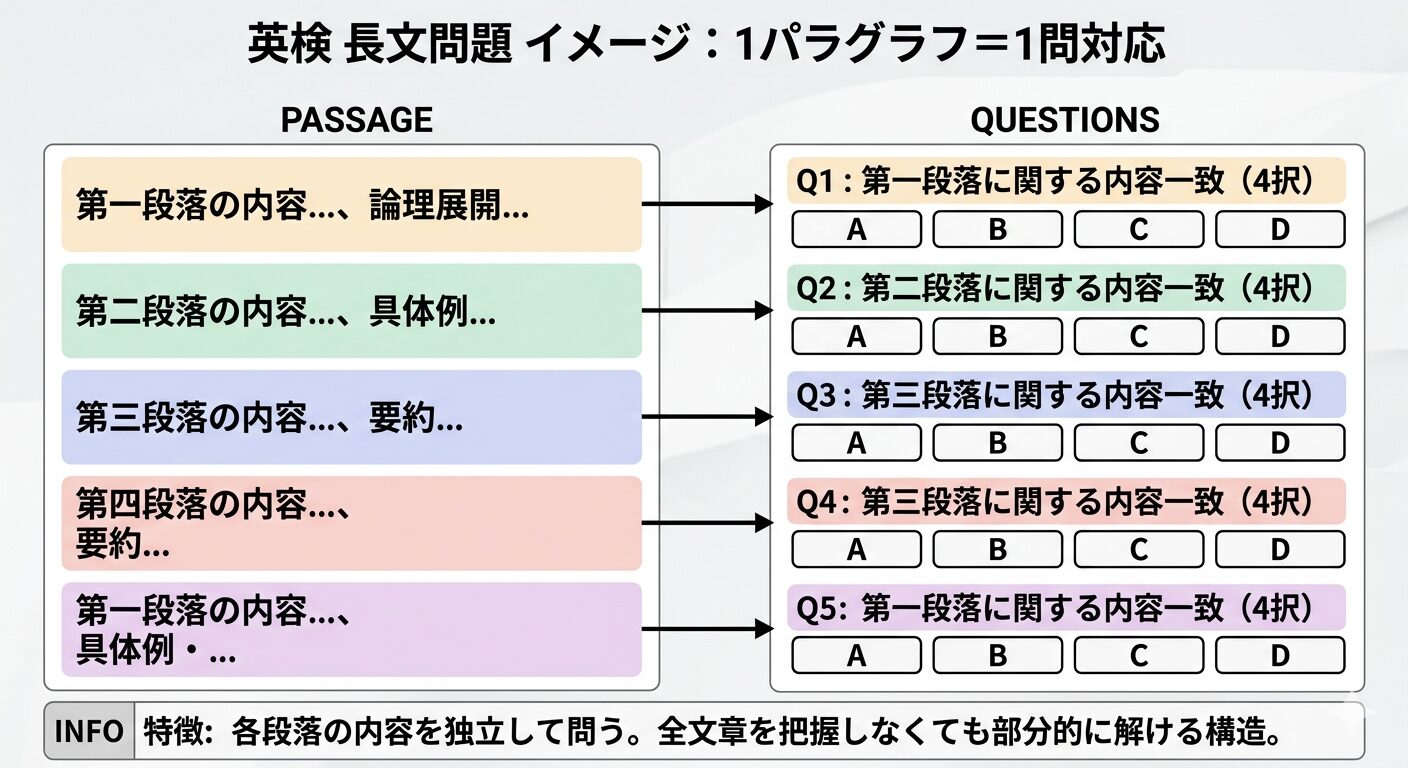
現在の英検(特に2級や準1級)の長文問題は、驚くほどパターン化されています。
第1段落の内容は問1
第2段落の内容は問2
というように、設問と段落が1対1で対応しています。この形式には、学習者の「真の読解力」を損なう2つの欠点があります。
① 「つまみ食い」で正解できてしまう
受験者は文章全体を俯瞰(ふかん)して理解しなくても、設問に関連するキーワードを特定の段落から探し出し、言い換え(パラフレーズ)を見つけるだけで「なんとなく」正解を選べてしまいます。これは「読解」というより、高度な**「キーワード照合パズル」**です。
② 難関大入試で通用しない「補助輪」
難関国立大学や早慶の長文は、パラグラフを跨いだ論理の逆転や、文章全体を貫く「筆者の主張」を問います。英検の「1対1対応」という補助輪に慣れすぎると、**「木を見て森を見ない」**読み方が癖になり、自力で情報の重要度を判断する力が養われません。
第1段落の内容は問1
第2段落の内容は問2
というように、設問と段落が1対1で対応しています。この形式には、学習者の「真の読解力」を損なう2つの欠点があります。
① 「つまみ食い」で正解できてしまう
受験者は文章全体を俯瞰(ふかん)して理解しなくても、設問に関連するキーワードを特定の段落から探し出し、言い換え(パラフレーズ)を見つけるだけで「なんとなく」正解を選べてしまいます。これは「読解」というより、高度な**「キーワード照合パズル」**です。
② 難関大入試で通用しない「補助輪」
難関国立大学や早慶の長文は、パラグラフを跨いだ論理の逆転や、文章全体を貫く「筆者の主張」を問います。英検の「1対1対応」という補助輪に慣れすぎると、**「木を見て森を見ない」**読み方が癖になり、自力で情報の重要度を判断する力が養われません。
「論理の繋がり」を試す:ケンブリッジ英検の「文挿入問題」
では、どのような問題が「真の読解力」を養うのでしょうか。
私が一つの理想的な代替案として提案したいのが、世界的に評価の高い**ケンブリッジ英検(Cambridge English Qualifications)で採用されている「Gapped Text(文挿入問題)」**です。
この形式は、長文から抜き出された数個の「文」を、元の正しい位置に戻すというものです。この問題を解くには、単なるキーワード探しではなく、以下の能力が不可欠です。
**指示語(this, these, they)**が何を指しているのか?
**論理接続詞(However, As a result)**は機能しているか?
代名詞の整合性は取れているか?
これらを分析するプロセスこそが、英語を「論理的に読む」ための本質的なトレーニングになります。
私が一つの理想的な代替案として提案したいのが、世界的に評価の高い**ケンブリッジ英検(Cambridge English Qualifications)で採用されている「Gapped Text(文挿入問題)」**です。
この形式は、長文から抜き出された数個の「文」を、元の正しい位置に戻すというものです。この問題を解くには、単なるキーワード探しではなく、以下の能力が不可欠です。
**指示語(this, these, they)**が何を指しているのか?
**論理接続詞(However, As a result)**は機能しているか?
代名詞の整合性は取れているか?
これらを分析するプロセスこそが、英語を「論理的に読む」ための本質的なトレーニングになります。
実際の問題
実際に、ケンブリッジ方式の問題を見てみましょう。「前後の文脈」を無視しては絶対に解けない構造になっています。
【問題】空所に当てはまる文を [ A~H ] から選びなさい。
How many times do you hear people say they don’t have time to do something? All the time! ‘I meant to do that, but I didn’t have time!’ is something we say or think far too often; it is the number one excuse for not doing something we should have done. [ 9 ] This is a relationship that has also changed a lot through history. Think about all the machines and time-saving gadgets that are now part of our everyday life, and that people living 100 or even 50 years ago had to do without: washing machines, vacuum cleaners, microwaves, and dishwashers are just a few. We have mobile phones now so that we can contact each other at any time, no matter where we are. The Internet gives us access to just about any information we could possibly want, as well as providing instant communication with people anywhere in the world. [10 ]
The concept of using time efficiently has gained significant importance in the Western world. In wealthy, developed countries, people often face expectations to juggle multiple jobs simultaneously. With high unemployment rates and intense international competition, both companies and individual workers experience considerable pressure to maximize efficiency and accomplish as much work as possible within the limited time available. [ 11 ] The concept of time pressure has also affected less developed countries, where many goods for developing nations are produced. In countries like India and Mexico, workers often endure long shifts, sometimes lasting 12 to 16 hours a day, and occasionally work up to 48 hours without a break. This demand for goods from the developed world places significant pressure on these workers to meet production requirements.
Time is increasingly becoming a commodity like any other. [ 12 ] Do you use self-service checkouts at the supermarket? Have you ever purchased furniture and assembled it yourself at home? Have you spent time setting up a new computer? If you have, then you've been working for free. Nowadays, it's possible to buy and sell time. For instance, you can pay someone to do your shopping or walk your dog if you're short on time, but these services can be quite expensive. A positive reflection of our changing relationship with time can be seen in some cities that have established time banks, where busy individuals can exchange time.[ 13 ] You will then be paid back in time when you need it. No money changes hands, but everyone has to pay into the bank in time.
The biggest challenge we face in our personal lives is managing our time effectively and avoiding waste. Recent research indicates that 20% of people frequently cancel social plans due to a lack of time, with men more likely than women to do so. However, canceling social arrangements can have serious negative consequences. It diminishes our quality of life and prevents us from engaging in activities we enjoy, which may lead to unhappiness. [ 14 ] This doesn’t have to be something active or sociable; it might be finding time to read a good book. By making sure we don’t miss out on the things we enjoy and value, we are likely to be happier and more satisfied with life in general.
The key to making the most of our time, both at work and in our personal lives, is prioritising. It is important to recognise which things need to be done immediately and which can wait until later. [ 15 ]Many people believe that revising for exams or completing homework at the last minute is an effective way to save time; however, this approach often yields poorer results. Psychologists suggest that individuals who are consistently punctual tend to be organized and have a good grasp of their responsibilities. Conversely, those who are frequently early may be anxious and feel the need to be in control at all times. On the other hand, people who often arrive late might simply be disorganized, or they may be intentionally or unintentionally resisting our time-focused society.
A In spite of these new inventions, we still run out of time.
В If you have some free time, you can volunteer to do something for someone else, like wait for a delivery or water their plants while they are on holiday.
С As a result, working hours have increased by 25% in the USA and in Japan, and workers sometimes sleep in the office.
D Time is money, and nowadays many companies try to save time and money by making their customers work for free.
E Time is a very precious commodity, and humans have always had a very close relationship with it.
F If you try to do too many things at once, you are more likely to make mistakes and waste time going back to correct them.
G This doesn’t mean we should put off things which are boring or difficult, just
because we don’t want to do them.
H It is important to find time for ourselves to do the things which matter most to us.
【問題】空所に当てはまる文を [ A~H ] から選びなさい。
How many times do you hear people say they don’t have time to do something? All the time! ‘I meant to do that, but I didn’t have time!’ is something we say or think far too often; it is the number one excuse for not doing something we should have done. [ 9 ] This is a relationship that has also changed a lot through history. Think about all the machines and time-saving gadgets that are now part of our everyday life, and that people living 100 or even 50 years ago had to do without: washing machines, vacuum cleaners, microwaves, and dishwashers are just a few. We have mobile phones now so that we can contact each other at any time, no matter where we are. The Internet gives us access to just about any information we could possibly want, as well as providing instant communication with people anywhere in the world. [10 ]
The concept of using time efficiently has gained significant importance in the Western world. In wealthy, developed countries, people often face expectations to juggle multiple jobs simultaneously. With high unemployment rates and intense international competition, both companies and individual workers experience considerable pressure to maximize efficiency and accomplish as much work as possible within the limited time available. [ 11 ] The concept of time pressure has also affected less developed countries, where many goods for developing nations are produced. In countries like India and Mexico, workers often endure long shifts, sometimes lasting 12 to 16 hours a day, and occasionally work up to 48 hours without a break. This demand for goods from the developed world places significant pressure on these workers to meet production requirements.
Time is increasingly becoming a commodity like any other. [ 12 ] Do you use self-service checkouts at the supermarket? Have you ever purchased furniture and assembled it yourself at home? Have you spent time setting up a new computer? If you have, then you've been working for free. Nowadays, it's possible to buy and sell time. For instance, you can pay someone to do your shopping or walk your dog if you're short on time, but these services can be quite expensive. A positive reflection of our changing relationship with time can be seen in some cities that have established time banks, where busy individuals can exchange time.[ 13 ] You will then be paid back in time when you need it. No money changes hands, but everyone has to pay into the bank in time.
The biggest challenge we face in our personal lives is managing our time effectively and avoiding waste. Recent research indicates that 20% of people frequently cancel social plans due to a lack of time, with men more likely than women to do so. However, canceling social arrangements can have serious negative consequences. It diminishes our quality of life and prevents us from engaging in activities we enjoy, which may lead to unhappiness. [ 14 ] This doesn’t have to be something active or sociable; it might be finding time to read a good book. By making sure we don’t miss out on the things we enjoy and value, we are likely to be happier and more satisfied with life in general.
The key to making the most of our time, both at work and in our personal lives, is prioritising. It is important to recognise which things need to be done immediately and which can wait until later. [ 15 ]Many people believe that revising for exams or completing homework at the last minute is an effective way to save time; however, this approach often yields poorer results. Psychologists suggest that individuals who are consistently punctual tend to be organized and have a good grasp of their responsibilities. Conversely, those who are frequently early may be anxious and feel the need to be in control at all times. On the other hand, people who often arrive late might simply be disorganized, or they may be intentionally or unintentionally resisting our time-focused society.
A In spite of these new inventions, we still run out of time.
В If you have some free time, you can volunteer to do something for someone else, like wait for a delivery or water their plants while they are on holiday.
С As a result, working hours have increased by 25% in the USA and in Japan, and workers sometimes sleep in the office.
D Time is money, and nowadays many companies try to save time and money by making their customers work for free.
E Time is a very precious commodity, and humans have always had a very close relationship with it.
F If you try to do too many things at once, you are more likely to make mistakes and waste time going back to correct them.
G This doesn’t mean we should put off things which are boring or difficult, just
because we don’t want to do them.
H It is important to find time for ourselves to do the things which matter most to us.
論理解説:なぜその選択肢か?
この問題の解答プロセスは、英検のそれとは全く異なります。
[ 9 ] E (Time is a very precious commodity...)
根拠: 直後の文で "This is a relationship that has also changed a lot through history" とあります。"This relationship" と受けるためには、前に「人間と時間の関係」についての言及が必要です。Eの "humans have always had a very close relationship with it" がこれに合致します。
[ 10 ] A (In spite of these new inventions...)
根拠: 直前で洗濯機やスマホなどの便利な発明品(inventions)が列挙されています。Aの "these new inventions" という指示語がこれらを完璧に指しており、「便利になったのに(逆接)、まだ時間が足りない」という文脈を完成させます。
[ 11 ] C (As a result, working hours have increased...)
根拠: 直前で、先進国における激しい競争や効率化のプレッシャー(pressure to maximize efficiency)について述べています。その「結果(As a result)」として、アメリカや日本で労働時間が増えたという統計データを繋ぐのが論理的です。
[ 12 ] D (Time is money, and nowadays many companies...)
根拠: 直前で "Time is increasingly becoming a commodity(時間は商品になりつつある)" と述べています。Dの冒頭 "Time is money" はその具体化であり、かつ直後の「セルフレジ」や「家具の組み立て」などの「客にタダで働かせる(working for free)」例へとスムーズに繋がります。
[ 13 ] B (If you have some free time, you can volunteer...)
根拠: 直前で "time banks(タイムバンク)" という「時間の交換システム」について触れています。Bは、その具体的な交換内容(荷物の受け取りを待つ、植物に水をやる等)を説明しており、具体例として最適です。
[ 14 ] H (It is important to find time for ourselves...)
根拠: 直後で "This doesn’t have to be something active..." とあります。"This" が指す内容として、「自分自身のために時間を見つけること」というHの内容が、意味的にも文法的にも合致しています。
[ 15 ] G (This doesn’t mean we should put off things...)
根拠: 直前で「優先順位をつけること(prioritising)」の大切さを説いています。Gの "This doesn’t mean..." は、「優先順位をつける=嫌なことを後回しにしていい、という意味ではない」と補足しており、論理的なフォローアップになっています。
[ 9 ] E (Time is a very precious commodity...)
根拠: 直後の文で "This is a relationship that has also changed a lot through history" とあります。"This relationship" と受けるためには、前に「人間と時間の関係」についての言及が必要です。Eの "humans have always had a very close relationship with it" がこれに合致します。
[ 10 ] A (In spite of these new inventions...)
根拠: 直前で洗濯機やスマホなどの便利な発明品(inventions)が列挙されています。Aの "these new inventions" という指示語がこれらを完璧に指しており、「便利になったのに(逆接)、まだ時間が足りない」という文脈を完成させます。
[ 11 ] C (As a result, working hours have increased...)
根拠: 直前で、先進国における激しい競争や効率化のプレッシャー(pressure to maximize efficiency)について述べています。その「結果(As a result)」として、アメリカや日本で労働時間が増えたという統計データを繋ぐのが論理的です。
[ 12 ] D (Time is money, and nowadays many companies...)
根拠: 直前で "Time is increasingly becoming a commodity(時間は商品になりつつある)" と述べています。Dの冒頭 "Time is money" はその具体化であり、かつ直後の「セルフレジ」や「家具の組み立て」などの「客にタダで働かせる(working for free)」例へとスムーズに繋がります。
[ 13 ] B (If you have some free time, you can volunteer...)
根拠: 直前で "time banks(タイムバンク)" という「時間の交換システム」について触れています。Bは、その具体的な交換内容(荷物の受け取りを待つ、植物に水をやる等)を説明しており、具体例として最適です。
[ 14 ] H (It is important to find time for ourselves...)
根拠: 直後で "This doesn’t have to be something active..." とあります。"This" が指す内容として、「自分自身のために時間を見つけること」というHの内容が、意味的にも文法的にも合致しています。
[ 15 ] G (This doesn’t mean we should put off things...)
根拠: 直前で「優先順位をつけること(prioritising)」の大切さを説いています。Gの "This doesn’t mean..." は、「優先順位をつける=嫌なことを後回しにしていい、という意味ではない」と補足しており、論理的なフォローアップになっています。
英検の「成功」が難関大入試で「通用しない」理由
① 「情報検索」vs「論理構築」
英検の長文は、特定の段落から正解を探し出す「情報検索(スキャニング)」がメインです。しかし、難関大の読解は、文章全体を貫く「筆者の主張」や「パラグラフ間の論理的相関」を問います。英検に慣れすぎると、**「木を見て森を見ない」**読み方が癖になり、パラグラフを跨いだ論理の逆転や、抽象的な概念の要約に対応できなくなります。
② 「言い換え探し」の限界
英検は、本文中の単語が選択肢でどう言い換えられているか(パラフレーズ)を見つければ、内容が半分程度の理解でも正解できてしまうことがあります。一方で、難関大の記述問題や複雑な選択肢は、**「文脈から意味を推論する力」**を求めます。単語のパズルではなく、文理の背景にある「論理の必然性」を理解していなければ、ひっかけの選択肢に容易に誘導されてしまうのです。
③ 「1対1対応」という補助輪の欠如
英検が提供する「1段落=1設問」という構造は、いわば**「読解の補助輪」**です。どこに答えがあるか最初から教えられているようなものです。補助輪を外された難関大の入試会場で、広大な英文の海を「自力で」航海する力、つまり、どこに重要な情報があるかを自分で判断する力が欠如していることに、多くの受験生がその時になって初めて気づくのです。
英検の長文は、特定の段落から正解を探し出す「情報検索(スキャニング)」がメインです。しかし、難関大の読解は、文章全体を貫く「筆者の主張」や「パラグラフ間の論理的相関」を問います。英検に慣れすぎると、**「木を見て森を見ない」**読み方が癖になり、パラグラフを跨いだ論理の逆転や、抽象的な概念の要約に対応できなくなります。
② 「言い換え探し」の限界
英検は、本文中の単語が選択肢でどう言い換えられているか(パラフレーズ)を見つければ、内容が半分程度の理解でも正解できてしまうことがあります。一方で、難関大の記述問題や複雑な選択肢は、**「文脈から意味を推論する力」**を求めます。単語のパズルではなく、文理の背景にある「論理の必然性」を理解していなければ、ひっかけの選択肢に容易に誘導されてしまうのです。
③ 「1対1対応」という補助輪の欠如
英検が提供する「1段落=1設問」という構造は、いわば**「読解の補助輪」**です。どこに答えがあるか最初から教えられているようなものです。補助輪を外された難関大の入試会場で、広大な英文の海を「自力で」航海する力、つまり、どこに重要な情報があるかを自分で判断する力が欠如していることに、多くの受験生がその時になって初めて気づくのです。
当校の哲学:英検を「大学入試」と「実戦」の武器に変える
英検の素材(英文)自体は、語彙の質もトピックの背景知識も非常に優れたものです。しかし、それを「何問正解したか」というスタンスで解き飛ばしてしまうのは、あまりにももったいない。
当校では、英検対策であっても、単に正解を選ぶだけでは終わらせません。
「なぜ他の選択肢はダメなのか?」を言語化させる
正解以外の3つの選択肢が、なぜ「言い過ぎ」なのか、あるいは「本文に言及がない」のかを論理的に説明させます。このプロセスが、難関大入試で問われる「紛らわしい選択肢」を見抜く眼を養います。
代名詞・指示語の徹底的な特定
"this", "they", "such" が具体的に何を指しているのか、常に指をさして確認させます。これは先ほどのケンブリッジ形式(文挿入)を解くための必須能力であり、英文を「線」でつなげる作業です。
精緻な下線部和訳のトレーニング
難関大学の二次試験を見据え、構文的に複雑な箇所はあえて和訳をさせます。なんとなく意味が取れる状態から、文法構造を100%把握した状態へ。この「解像度の高さ」が、英検合格の先にある学力の伸びを左右します。
英検は「合格」がゴールではありません。その素材をどう使い倒し、どう思考の訓練に充てるか。その**「生かし方」**によってのみ、本物の英語力は身につくのだと私は確信しています。単なる英検合格のとどまらない本質的英語力をお求めの方、英会話エスティームまでご相談下さい。
当校受講生の体験記→
無料体験を申し込む
ホームに戻る
当校では、英検対策であっても、単に正解を選ぶだけでは終わらせません。
「なぜ他の選択肢はダメなのか?」を言語化させる
正解以外の3つの選択肢が、なぜ「言い過ぎ」なのか、あるいは「本文に言及がない」のかを論理的に説明させます。このプロセスが、難関大入試で問われる「紛らわしい選択肢」を見抜く眼を養います。
代名詞・指示語の徹底的な特定
"this", "they", "such" が具体的に何を指しているのか、常に指をさして確認させます。これは先ほどのケンブリッジ形式(文挿入)を解くための必須能力であり、英文を「線」でつなげる作業です。
精緻な下線部和訳のトレーニング
難関大学の二次試験を見据え、構文的に複雑な箇所はあえて和訳をさせます。なんとなく意味が取れる状態から、文法構造を100%把握した状態へ。この「解像度の高さ」が、英検合格の先にある学力の伸びを左右します。
英検は「合格」がゴールではありません。その素材をどう使い倒し、どう思考の訓練に充てるか。その**「生かし方」**によってのみ、本物の英語力は身につくのだと私は確信しています。単なる英検合格のとどまらない本質的英語力をお求めの方、英会話エスティームまでご相談下さい。
当校受講生の体験記→
無料体験を申し込む
ホームに戻る
[addtoany]