
「子供っぽい英語」を卒業する鍵:英語のOSを書き換えろ→無生物主語」の思考法
英検のライティングや大学入試の自由英作文など、現在の英語教育では「発信すること」が非常に重視されています。しかし、現場で多くの答案を見ていると、ある深刻な事態に気づきます。
「単語や文法は間違っていないのに、論理が日本人のままで、英語として機能していない」
例えば、海外から来た人に「なぜ日本に来たのですか?」と尋ねるシーンを想像してみてください。
日本語論理: "Why did you come to Japan?"
英語論理: "What brought you to Japan?"(何があなたを日本へ連れてきたのですか?)
前者は単なる理由の問いかけですが、後者は「物や出来事」を主語に据えた、英語本来の洗練された響きを持っています。この「英語に内在する論理」を学ばないまま、どれだけ練習を重ねても、英語力はある地点で完全にスタック(停滞)してしまいます。
「単語や文法は間違っていないのに、論理が日本人のままで、英語として機能していない」
例えば、海外から来た人に「なぜ日本に来たのですか?」と尋ねるシーンを想像してみてください。
日本語論理: "Why did you come to Japan?"
英語論理: "What brought you to Japan?"(何があなたを日本へ連れてきたのですか?)
前者は単なる理由の問いかけですが、後者は「物や出来事」を主語に据えた、英語本来の洗練された響きを持っています。この「英語に内在する論理」を学ばないまま、どれだけ練習を重ねても、英語力はある地点で完全にスタック(停滞)してしまいます。
1. 英語は「物」が主役、日本語は「状況」が主役
.私たちが英語を話すとき、無意識に「日本語のOS」を引きずっています。その最大の差は、**「誰が(何が)その場面を動かしているか」**という視点にあります。
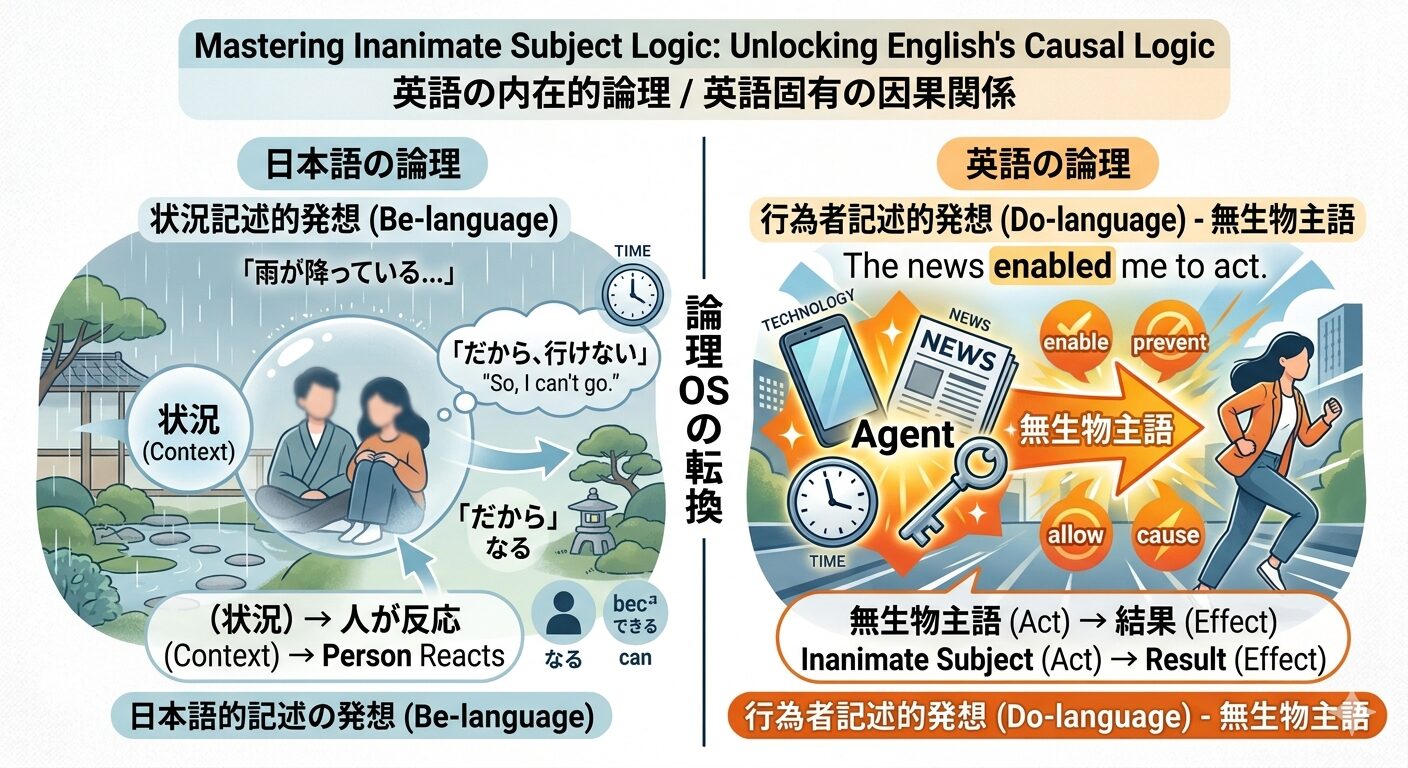
日本語:状況が人を包み込む「背景の論理」
日本語は、話し手を取り囲む「状況」や「雰囲気」を記述するのが得意な言語です。これを言語学では**「なる(Be-language)」**の論理と呼びます。
視点: 映画のカメラが風景全体を映し出し、その中にポツンと人が立っているイメージ。
思考プロセス: 「雨が降っている(状況)」→ 「だから私は行けない(結果)」。
特徴: 主語をあえて立てず、状況の流れに身を任せる表現になります。
英語:物が人に干渉する「衝突の論理」
対して英語は、たとえ無生物であっても、あたかも意志を持った「行為者(エージェント)」のように扱います。これを**「する(Do-language)」**の論理と呼びます。
視点: カメラが「原因(物)」をクローズアップし、それが「対象(人)」にグイッと干渉する瞬間を捉えるイメージ。
思考プロセス: 「雨(原因)」→ 「妨げる(動作)」→ 「私(対象)」。
特徴: 抽象的な概念(時間、ニュース、道具、感情)が主語になり、他動詞を使って「結果」をダイレクトに引き起こします。
「状況の奴隷」から「論理の操縦者」へ
日本語論理で話している限り、私たちは常に「状況」の後に続く受動的な存在です。
Japanese Logic: "Because the bus was late, I was late for the meeting."
(バスが遅れたので、私は会議に遅れました。=状況の説明)
しかし、英語のOSに切り替えると、バスという「物」が私を遅刻させたという、明確な因果関係の責任所在が浮き彫りになります。
English Logic: "The bus delay caused me to miss the meeting."
(バスの遅延が、私に会議を逃させた。=論理の記述)
この「物」を主役に据える発想こそが、文章を簡潔にし、説得力ある英語を生む「論理的客観性」を生むのです。
日本語の発想で英語を書くと、どうしても主語が「I」や「We」ばかりになり、「Because...」や「If...」を多用した説明的な文章になりがちです。
日本語論理(状況中心): 「雨が降ったから、私は行けなかった。」
Japanese Logic: "Because it rained, I couldn't go."
英語論理(行為者中心): 「雨が、私が行くのを妨げた。」
English Logic: "The rain prevented me from going."
日本語:状況が人を包み込む「背景の論理」
日本語は、話し手を取り囲む「状況」や「雰囲気」を記述するのが得意な言語です。これを言語学では**「なる(Be-language)」**の論理と呼びます。
視点: 映画のカメラが風景全体を映し出し、その中にポツンと人が立っているイメージ。
思考プロセス: 「雨が降っている(状況)」→ 「だから私は行けない(結果)」。
特徴: 主語をあえて立てず、状況の流れに身を任せる表現になります。
英語:物が人に干渉する「衝突の論理」
対して英語は、たとえ無生物であっても、あたかも意志を持った「行為者(エージェント)」のように扱います。これを**「する(Do-language)」**の論理と呼びます。
視点: カメラが「原因(物)」をクローズアップし、それが「対象(人)」にグイッと干渉する瞬間を捉えるイメージ。
思考プロセス: 「雨(原因)」→ 「妨げる(動作)」→ 「私(対象)」。
特徴: 抽象的な概念(時間、ニュース、道具、感情)が主語になり、他動詞を使って「結果」をダイレクトに引き起こします。
「状況の奴隷」から「論理の操縦者」へ
日本語論理で話している限り、私たちは常に「状況」の後に続く受動的な存在です。
Japanese Logic: "Because the bus was late, I was late for the meeting."
(バスが遅れたので、私は会議に遅れました。=状況の説明)
しかし、英語のOSに切り替えると、バスという「物」が私を遅刻させたという、明確な因果関係の責任所在が浮き彫りになります。
English Logic: "The bus delay caused me to miss the meeting."
(バスの遅延が、私に会議を逃させた。=論理の記述)
この「物」を主役に据える発想こそが、文章を簡潔にし、説得力ある英語を生む「論理的客観性」を生むのです。
日本語の発想で英語を書くと、どうしても主語が「I」や「We」ばかりになり、「Because...」や「If...」を多用した説明的な文章になりがちです。
日本語論理(状況中心): 「雨が降ったから、私は行けなかった。」
Japanese Logic: "Because it rained, I couldn't go."
英語論理(行為者中心): 「雨が、私が行くのを妨げた。」
English Logic: "The rain prevented me from going."
2. 実践:無生物を「主役」にするだけで英語は劇的に変わる
英語本来の論理(無生物が主語)へ転換する例を見てみましょう。これを使うだけで、文章の情報密度は飛躍的に高まります。
※( )内は英語の論理を理解するための直訳です。
allow
Because we have the internet, we can work from anywhere.
The internet allows us to work from anywhere. (ネットが、どこでも働くことを許容する)
lead to
If you make a small mistake, it will become a big problem.
A small mistake can lead to a serious problem. (小さなミスが、重大な問題へと導く)
cause
Because it rained heavily, the game was cancelled.
The heavy rain caused the cancellation of the game. (激しい雨が、試合の中止を引き起こした)
enable
If you use this software, you can edit videos easily.
This software enables easy video editing. (このソフトが、動画編集を可能にする)
deprive
Because he had to work hard, he couldn't sleep enough.
Hard work deprived him of sufficient sleep.(激務が、彼から十分な睡眠を奪った)
say / tell
I read in the newspaper that the economy is recovering.
The newspaper says that the economy is recovering. (新聞が、経済は回復していると言っている)
※( )内は英語の論理を理解するための直訳です。
allow
Because we have the internet, we can work from anywhere.
The internet allows us to work from anywhere. (ネットが、どこでも働くことを許容する)
lead to
If you make a small mistake, it will become a big problem.
A small mistake can lead to a serious problem. (小さなミスが、重大な問題へと導く)
cause
Because it rained heavily, the game was cancelled.
The heavy rain caused the cancellation of the game. (激しい雨が、試合の中止を引き起こした)
enable
If you use this software, you can edit videos easily.
This software enables easy video editing. (このソフトが、動画編集を可能にする)
deprive
Because he had to work hard, he couldn't sleep enough.
Hard work deprived him of sufficient sleep.(激務が、彼から十分な睡眠を奪った)
say / tell
I read in the newspaper that the economy is recovering.
The newspaper says that the economy is recovering. (新聞が、経済は回復していると言っている)
3. 「英検合格」のその先にある、真の英語力
正直に言いましょう。英検2級程度までなら、日本語論理のまま「I think... Because...」と書き連ねても、文法さえ合っていれば合格点は取れるかもしれません。しかし、そこが大きな落とし穴です。
「合格はしたけれど、なぜか自分の英語は子供っぽく、説得力がない」
そう感じたことはありませんか? 準1級や1級、さらには海外の大学院やビジネスの第一線で求められるのは、単なる「正解」ではなく、**「グローバルスタンダードの論理(Logic)」**です。
洗練された語彙の運用: facilitate や alleviate といった高度な動詞は、無生物を主語にして初めてその真価を発揮します。
情報の凝縮: 無生物主語を使うことで接続詞への依存が減り、論理が一直線に突き刺さる強靭な文章になります。
「合格はしたけれど、なぜか自分の英語は子供っぽく、説得力がない」
そう感じたことはありませんか? 準1級や1級、さらには海外の大学院やビジネスの第一線で求められるのは、単なる「正解」ではなく、**「グローバルスタンダードの論理(Logic)」**です。
洗練された語彙の運用: facilitate や alleviate といった高度な動詞は、無生物を主語にして初めてその真価を発揮します。
情報の凝縮: 無生物主語を使うことで接続詞への依存が減り、論理が一直線に突き刺さる強靭な文章になります。
結論:まず「脳のOS」を書き換えろ
英語は、無味乾燥な単語の暗記科目ではありません。それは、私たちが慣れ親しんだ日本語とは全く異なる「世界の捉え方」を学ぶ知的なプロセスです。
「私たちは〜できる(We can...)」という思考を一度封印し、**「何がそれを可能にしているのか(The tool enables...)」**を主語に据える。この「論理の転換」こそが、日本人という檻を抜け出し、世界と対等に渡り合うための唯一の鍵なのです。
追伸
もしあなたが、今の英語学習に限界を感じているなら、自分の書いた英文の「主語」をチェックしてみてください。もし「I」や「We」ばかりなら、あなたの英語力はまだ「日本語の檻」の中に閉じ込められています。ここから脱皮して次のステージに英語を引き上げたい方、英会話エスティームまでご相談下さい。
当校受講生の体験記→
無料体験を申し込む
ホームに戻る
「私たちは〜できる(We can...)」という思考を一度封印し、**「何がそれを可能にしているのか(The tool enables...)」**を主語に据える。この「論理の転換」こそが、日本人という檻を抜け出し、世界と対等に渡り合うための唯一の鍵なのです。
追伸
もしあなたが、今の英語学習に限界を感じているなら、自分の書いた英文の「主語」をチェックしてみてください。もし「I」や「We」ばかりなら、あなたの英語力はまだ「日本語の檻」の中に閉じ込められています。ここから脱皮して次のステージに英語を引き上げたい方、英会話エスティームまでご相談下さい。
当校受講生の体験記→
無料体験を申し込む
ホームに戻る
Exercise: The "Agent-Oriented" Logic Challenge
Instructions: Unscramble the words to answer the questions. Focus on making the inanimate object (the "Thing") the subject of your sentence.
1. How far is it from here to the station?
( a five-minute / will take / walk / there / you / )
Answer: ________________________________________________
2. Why did you decide to study English in London?
( to London / my passion / brought / for music / me / )
Answer: ________________________________________________
3. How did you find out about the secret meeting?
( about the meeting / the morning newspaper / me / told / )
Answer: ________________________________________________
4. Why couldn't you finish the marathon yesterday?
( me / from finishing / the extreme heat / prevented / the race / )
Answer: ________________________________________________
5. How can we reduce the cost of this project?
( of money / us / this new software / a lot / will save / )
Answer: ________________________________________________
6. Why is he so tired today?
( of sleep / him / last night’s heavy work / deprived / )
Answer: ________________________________________________
7. How did you know she was disappointed?
( the truth / her silent reaction / me / told / )
Answer: ________________________________________________
8. Why are you able to work from the beach today?
( from anywhere / the high-speed Wi-Fi / to work / allows / us / )
Answer: ________________________________________________
9. What made the car suddenly stop?
( the engine failure / to a halt / the car / brought / )
Answer: ________________________________________________
10. How did you become such a good guitar player?
( hours of practice / a professional / made / me / )
Answer: ________________________________________________
Answer Key (The English "Inate Logic" OS)
A five-minute walk will take you there.
My passion for music brought me to London.
The morning newspaper told me about the meeting.
The extreme heat prevented me from finishing the race.
This new software will save us a lot of money.
Last night’s heavy work deprived him of sleep.
Her silent reaction told me the truth.
The high-speed Wi-Fi allows us to work from anywhere.
The engine failure brought the car to a halt.
Hours of practice made me a professional.
1. How far is it from here to the station?
( a five-minute / will take / walk / there / you / )
Answer: ________________________________________________
2. Why did you decide to study English in London?
( to London / my passion / brought / for music / me / )
Answer: ________________________________________________
3. How did you find out about the secret meeting?
( about the meeting / the morning newspaper / me / told / )
Answer: ________________________________________________
4. Why couldn't you finish the marathon yesterday?
( me / from finishing / the extreme heat / prevented / the race / )
Answer: ________________________________________________
5. How can we reduce the cost of this project?
( of money / us / this new software / a lot / will save / )
Answer: ________________________________________________
6. Why is he so tired today?
( of sleep / him / last night’s heavy work / deprived / )
Answer: ________________________________________________
7. How did you know she was disappointed?
( the truth / her silent reaction / me / told / )
Answer: ________________________________________________
8. Why are you able to work from the beach today?
( from anywhere / the high-speed Wi-Fi / to work / allows / us / )
Answer: ________________________________________________
9. What made the car suddenly stop?
( the engine failure / to a halt / the car / brought / )
Answer: ________________________________________________
10. How did you become such a good guitar player?
( hours of practice / a professional / made / me / )
Answer: ________________________________________________
Answer Key (The English "Inate Logic" OS)
A five-minute walk will take you there.
My passion for music brought me to London.
The morning newspaper told me about the meeting.
The extreme heat prevented me from finishing the race.
This new software will save us a lot of money.
Last night’s heavy work deprived him of sleep.
Her silent reaction told me the truth.
The high-speed Wi-Fi allows us to work from anywhere.
The engine failure brought the car to a halt.
Hours of practice made me a professional.
[addtoany]